PARK: Parkinson's screening from a webcam

About 900,000 people in the United States live with Parkinson's disease, and more than 40% of those over 65 never see a neurologist. PARK (Parkinson's Analysis with Remote Kinetic-tasks) lets anyone take standard neurological tasks in a web browser, whenever and wherever they want, and uses AI to screen for Parkinson's and measure its severity from the recordings.

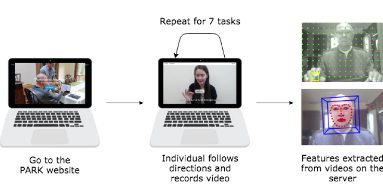
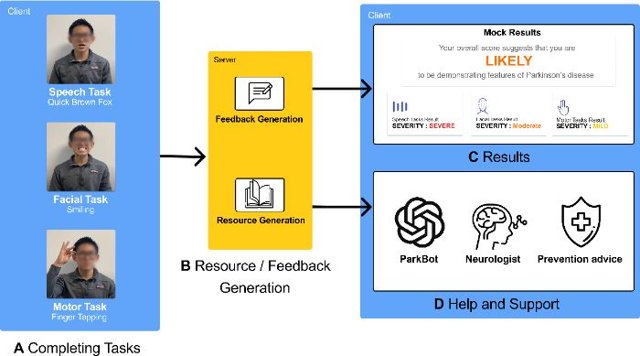
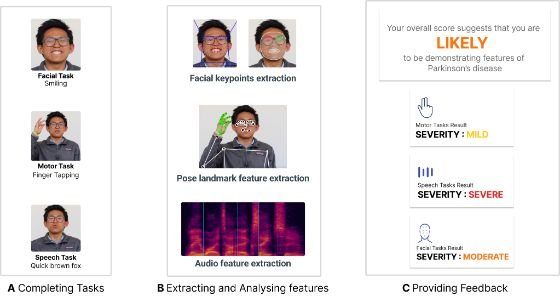
PARK in three steps: a person completes short tasks on a webcam (smiling, finger tapping, reading a sentence aloud), AI extracts facial, motion and voice features, and the person receives feedback.
1,865participants in the multimodal, cross-setting validation (Communications Medicine 2026)
3 tasksa smile, finger tapping and a spoken sentence, recorded on any webcam in a few minutes
~86%accuracy from two spoken sentences alone (npj Parkinson's Disease 2025)
32,847videos in our benchmark of video foundation models for Parkinson's screening (MICCAI 2026)

2018 to 2020

The PARK framework: a neurological exam in the browser

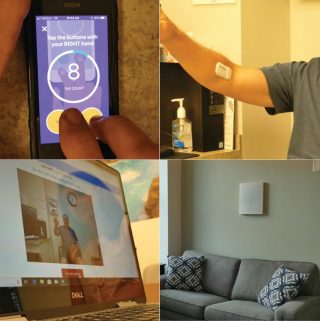
Working with neurologist Ray Dorsey, we built a website that guides people through tasks from the Movement Disorder Society's rating scale (MDS-UPDRS), records them on a webcam, and analyzes the videos automatically. Because it runs in any browser, people can take part from home, including in rural areas and places with few neurologists.

2021 to 2025

Listening for Parkinson's in speech

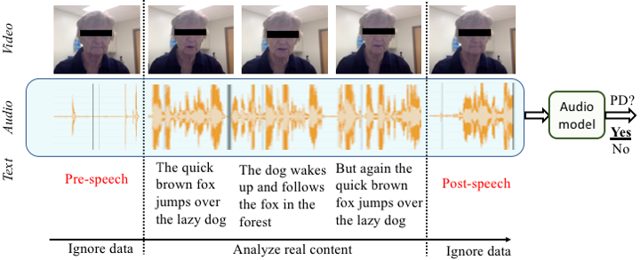
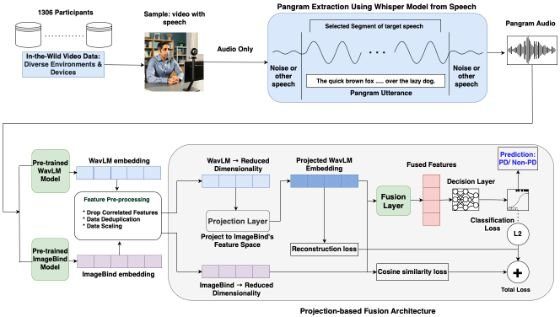
Nearly 9 in 10 people with Parkinson's have changes in their voice. Our online speech test asks people to read pangrams such as 'The quick brown fox jumps over the lazy dog'. A fusion model built on large semi-supervised speech models flags Parkinson's with about 86% accuracy, approaching expert neurologists. The work suggests voice assistants could, with consent, help people decide when to seek care.

  • Detecting Parkinson's Disease from an Online Speech-Task: Observational Study W. Chowdhury, S. Lee, M. S. Islam, V. Antony, H. Ratnu, M. R. Ali, A. Mamun, E. Wagner, S. Jensen-Roberts, E. Waddell, T. Myers, M. Pawlik, J. Soto, M. Coffey, A. Sarkar, R. Schneider, C. Tarolli, K. Lizarraga, J. Adams, M. Little, E. R. Dorsey, and E. Hoque Journal of Medical Internet Research 23(10), 2021 Anyone, anywhere can record one sentence online to screen for Parkinson's. With 726 participants across the US and beyond, speech features alone reached 0.75 AUC.
  • A Novel Fusion Architecture for PD Detection Using Semi-Supervised Speech Embeddings T. Adnan, A. Abdelkader, Z. Liu, E. Hossain, S. Park, M. S. Islam, and E. Hoque npj Parkinson's Disease 11(1), 2025 Screening for Parkinson's from one spoken sentence recorded at home. A fusion of modern speech embeddings, trained on 1,306 people (392 with PD), beats traditional acoustic features and holds up across demographics.

2021 to 2025

A smile can reveal Parkinson's

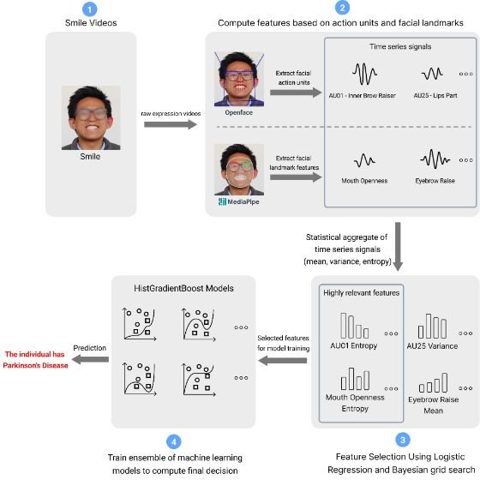
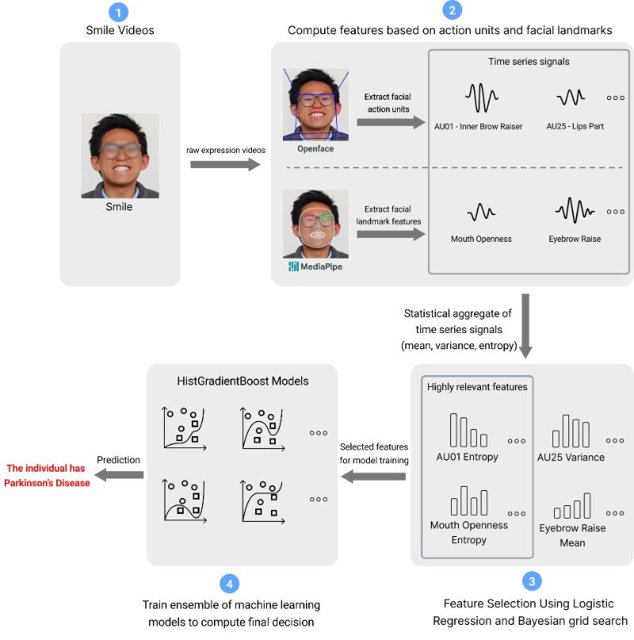
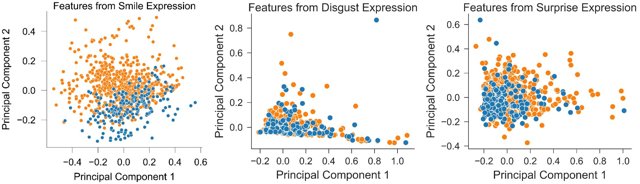
Reduced facial expressivity (hypomimia) is an early sign of Parkinson's. From smile videos recorded on webcams by participants around the world, our models pick up subtle changes in facial muscle movement that clinicians can miss, published in NEJM AI in 2025.

  • AI-Enabled Parkinson's Disease Screening Using Smile Videos T. Adnan, M. S. Islam, S. Lee, E. M. W. R. Chowdhury, S. D. Tithi, K. Noshin, M. R. Islam, I. Sarker, M. S. Rahman, R. B. Schneider, J. L. Adams, E. R. Dorsey, and E. Hoque NEJM AI 2(7), 2025 A smile recorded on a webcam can flag Parkinson's. Using facial-expression videos from 1,059 people recorded at home and in clinics, the model detects reduced facial expressivity (hypomimia) and was tested on external videos it never saw in training. Published in NEJM AI.
  • Unmasking Parkinson's Disease Using Smiles: An AI-Enabled Screening Framework T. Adnan et al. Future of Parkinson's Disease Conference, Austin, 2023 · Best Abstract in Clinical Research
  • Longitudinal Evaluation of Hypomimia in Individuals with Parkinson's Disease Using a Video Analytics Tool P. T. Yang et al. International Congress of Parkinson's Disease and Movement Disorders (MDS 2022), Madrid, 2022

2023

Measuring severity at home with finger tapping

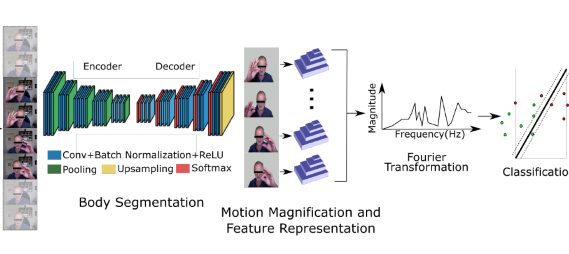
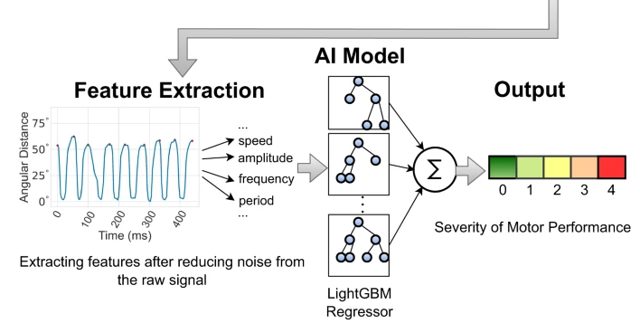
Finger tapping is a core test of slowness in Parkinson's. Our model rates finger-tapping severity from home videos, performing better than non-specialist physicians and close to expert neurologists, so symptoms can be tracked between clinic visits.

  • Using AI to Measure Parkinson's Disease Severity at Home M. S. Islam, W. Rahman, A. Abdelkader, S. Lee, P. T. Yang, J. L. Purks, J. L. Adams, R. B. Schneider, E. R. Dorsey, and E. Hoque npj Digital Medicine 6, 2023 Tap your fingers in front of a webcam and AI rates Parkinson's severity. On 250 people worldwide, the model outperformed a certified rater (error 0.59 vs 0.79) and approached expert neurologists.

2024 to 2026

Combining tasks, and validating across settings

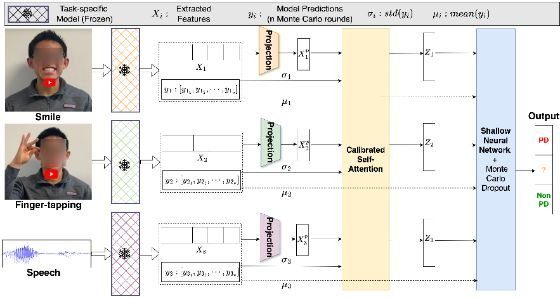
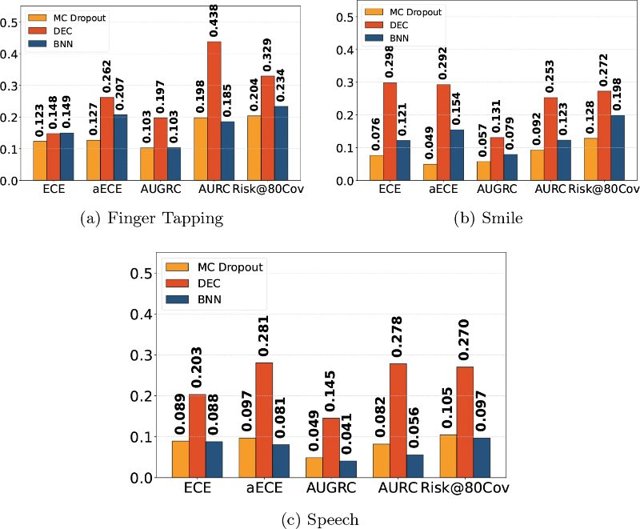
Each task carries part of the signal. Combining video of several tasks with uncertainty-aware fusion improves screening, and a validation study with 1,865 participants tested the system at home, in clinics and in care centers across diverse populations. The models also report how confident they are, so uncertain cases can be sent for review.

  • Validation of Remote Multimodal AI Screening for Parkinson Disease Across Diverse Settings M. S. Islam, T. Adnan, A. Abdelkader, Z. Liu, E. Ma, S. Park, A. Azad, P. Liu, M. Pawlik, E. Hartman, E. Shelton, K. B. Larson, M. S. Rahman, C. Schwartz, K. Jaffe, J. L. Adams, R. B. Schneider, J. Freyberg, E. R. Dorsey, and E. Hoque Communications Medicine, 2026 · In press Can a few minutes in front of a webcam screen for Parkinson's? This study validates our multimodal PARK screening (speech, facial expression, finger tapping) across diverse settings, a step from lab prototype toward real-world use.
  • Accessible, At-Home Detection of Parkinson's Disease via Multi-task Video Analysis M. S. Islam, T. Adnan, J. Freyberg, S. Lee, A. Abdelkader, M. Pawlik, C. Schwartz, K. Jaffe, R. B. Schneider, E. R. Dorsey, and E. Hoque AAAI Conference on Artificial Intelligence (AAAI 2025), 2025 Parkinson's affects movement, face and voice, so we combine all three. UFNet fuses webcam videos of finger tapping, facial expression and speech from 845 people and weighs each task by its uncertainty, improving at-home detection (AAAI 2025).
  • Beyond Accuracy: Enhancing Parkinson's Diagnosis with Uncertainty Quantification of Machine Learning Models A. Azad, M. S. Islam, E. Hoque, and M. S. Rahman International Conference on AI in Healthcare (AIiH 2025), University of Cambridge, 2025 · Best Paper Nomination A Parkinson's prediction is only useful if you know when to trust it. This work adds uncertainty quantification to PD screening models so low-confidence cases can be flagged for clinicians. Best Paper nominee.

2026

Catching Parkinson's before diagnosis

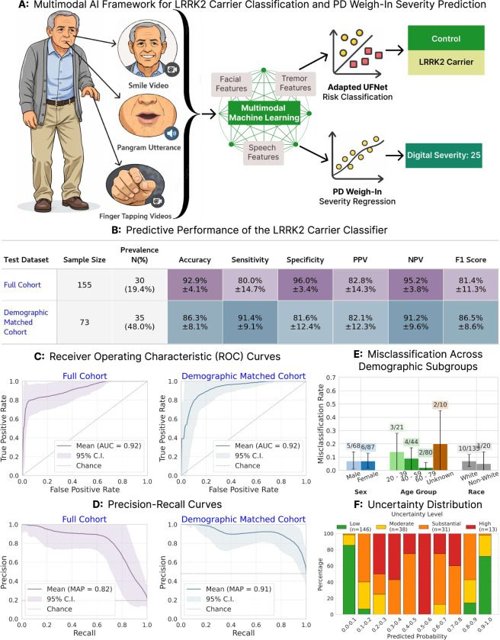
People who carry LRRK2 gene variants are at high risk of developing Parkinson's, and finding change early matters most for them. With Ruth Schneider, we studied 829 participants, including 158 LRRK2 carriers, using the same remote webcam tasks. The model told carriers without symptoms apart from controls with 92.9% accuracy, and a continuous score, the PD Weigh-In, captured decline in two carriers who later developed Parkinson's and tracked expert ratings closely (r = 0.77).

  • Multimodal Remote Digital Phenotyping for Detecting and Tracking Early Parkinsonian Change in LRRK2 Carriers T. M. T. Adnan, A. Abdelkader, M. S. Islam, M. Pawlik, E. Hartman, E. Hoque, and R. B. Schneider Research Square (preprint), 2026 · Preprint People who carry LRRK2 gene variants are at high risk of Parkinson's. From remote webcam tasks by 829 participants, including 158 LRRK2 carriers, our model told carriers without symptoms apart from controls with 92.9% accuracy, and a continuous score tracked decline in two carriers who later developed Parkinson's.

2026

Foundation models for movement

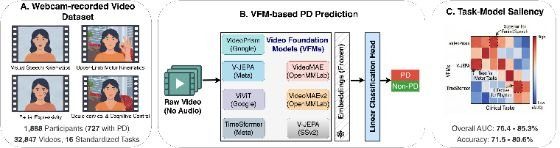
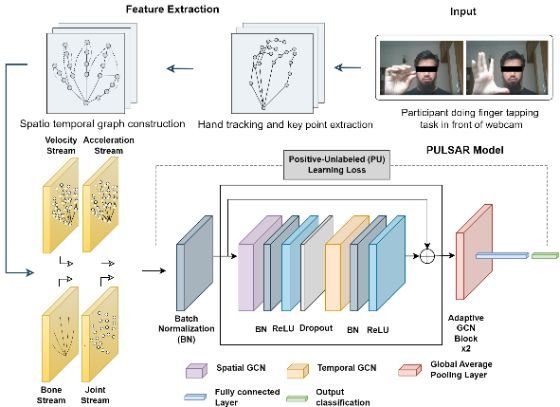
We benchmarked seven video foundation models on 32,847 webcam videos from 1,888 participants (727 with Parkinson's) across 16 standardized tasks, finding that the best model depends on the task, and built PULSAR, a graph-based model that learns from partially labeled data. These are steps toward general models of human movement for neurological care.

Beyond screening: ataxia, gait and daily life

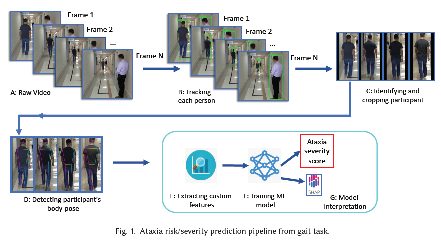
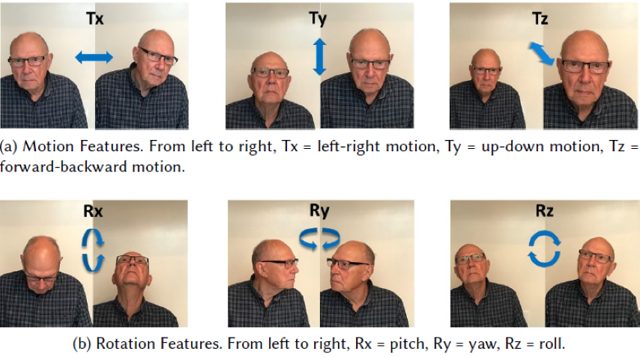
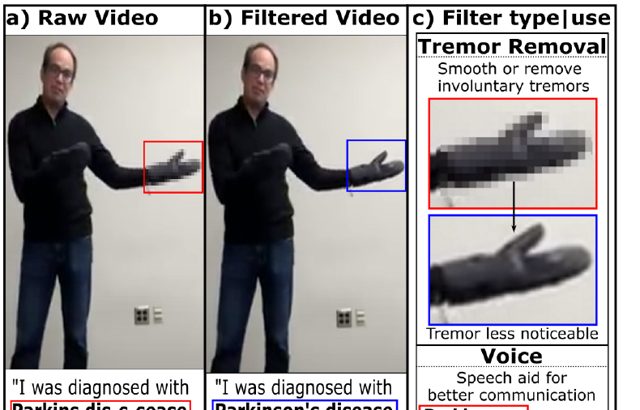
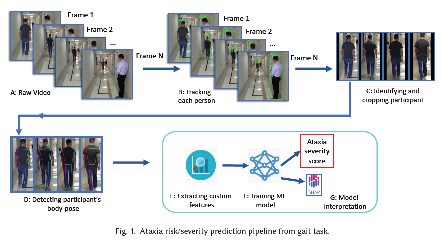
The same approach extends to other movement disorders and to the lives of people with Parkinson's: gait videos to assess ataxia risk, head pose in remote videos, a week of data from four digital technologies, a user-centered framework co-designed with people with Parkinson's, and video filters that remove tremor and adjust voice during video calls (ACII 2022 best paper nominee).

  • Auto-Gait: Automatic Ataxia Risk Assessment with Computer Vision from Gait Task Videos W. Rahman, M. Hasan, M. S. Islam, T. Olubajo, J. Thaker, A. Abdelkader, P. Yang, H. Paulson, G. Oz, A. Durr, T. Klockgether, T. Ashizawa, and E. Hoque Proceedings of the ACM on Interactive, Mobile, Wearable and Ubiquitous Technologies (IMWUT), 2023 Webcam gait videos analyzed with computer vision to estimate risk of spinocerebellar ataxia, a step toward remote screening for rare movement disorders.
  • Analyzing Gait Videos to Identify and Evaluate Spinocerebellar Ataxia Types 1 and 3 P. T. Yang et al. International Congress of Parkinson's Disease and Movement Disorders (MDS 2022), Madrid, 2022
  • Analyzing Head Pose in Remotely-Collected Videos of People with Parkinson's Disease M. R. Ali, T. K. Sen, Q. Li, R. Langevin, T. Myers, S. Sharma, E. R. Dorsey, and E. Hoque ACM Transactions on Computing for Healthcare 2(4), 2021 Head movement in home-recorded videos carries signal about Parkinson's, supporting remote assessment without special hardware.
  • A Week in the Life with Parkinson's Disease: A Holistic Overview from Four Digital Technologies E. A. Hartman et al. International Congress of Parkinson's Disease and Movement Disorders (MDS 2022), Madrid, 2022
  • A User-Centered Framework to Empower People with Parkinson's Disease W. Rahman, A. Abdelkader, S. Lee, P. Yang, M. S. Islam, T. Adnan, M. Hasan, E. Wagner, S. Park, E. R. Dorsey, C. Schwartz, K. Jaffe, and E. Hoque Proceedings of the ACM on Interactive, Mobile, Wearable and Ubiquitous Technologies (IMWUT) 7(4), 2024 Designed with people with Parkinson's, this framework turns at-home video screening into feedback and resources users can act on.
  • Assistive Video Filters for People with Parkinson's Disease to Remove Tremors and Adjust Voice K. Haut, A. Blumenthal, S. Atterbury, X. Zhou, W. Rahman, E. Natali, M. R. Ali, and E. Hoque Affective Computing and Intelligent Interaction (ACII 2022), 2022 · Best Paper Nomination Real-time video filters that smooth visible tremors and adjust voice, so people with Parkinson's can feel more comfortable on video calls. Best Paper nominee led by undergraduates.
  • Getting on the Right Foot: Using Observational and Quantitative Methods to Evaluate Movement Disorders J. Spann, S. Chen, T. Ashizawa, and E. Hoque ACM Conference on Intelligent User Interfaces (IUI 2024), 2024 Combines clinical observation and quantitative video analysis to evaluate gait in movement disorders.

More

← All research