PTSD screening

Post-traumatic stress disorder goes undiagnosed where it is most common: refugee camps, military settings and places with few clinicians, language barriers and stigma. We build low-cost ways to screen for PTSD and to support therapy, designed for the people and settings that need them.

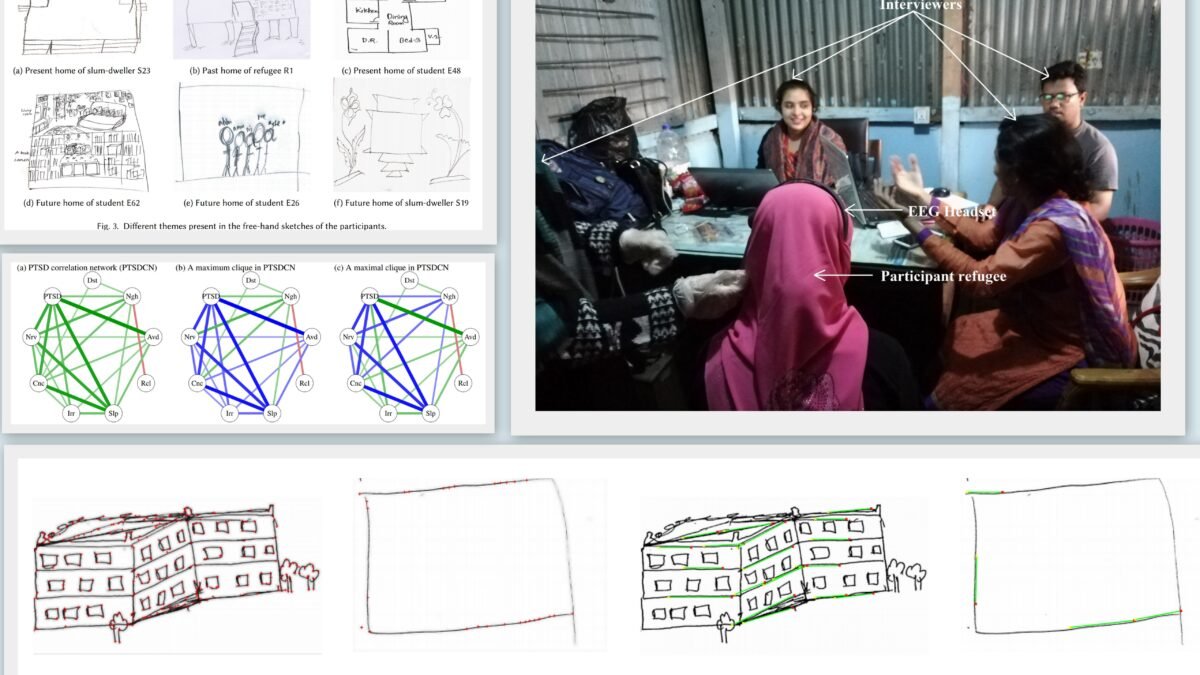
Fieldwork with Rohingya refugees in Bangladesh: free-hand sketches, a portable EEG headset and interviews.
82.9 to 87.9%screening accuracy from three simple sketch features (study with Rohingya refugees)
$1.2MNSF collective sensing system for PTSD therapy
PCL-5standard PTSD checklist delivered by a culturally adapted virtual agent

Screening with free-hand sketches and portable EEG

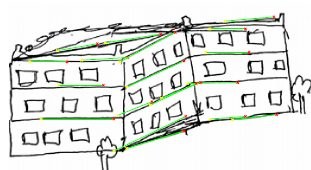
In a study with Rohingya refugees in Bangladesh, we tested a short questionnaire, a low-cost portable EEG headset and free-hand drawings. Three features of a sketch (number of corners, number of strokes and average stroke length) screened for PTSD with 82.9 to 87.9% accuracy, and adding EEG pushed accuracy higher. The methods are cheap enough to eventually run on a phone.

  • Leveraging Free-Hand Sketches for Potential Screening of PTSD F. Shahid, W. Rahman, M. S. Rahman, S. Purabi, A. Seddiqa, M. Mostakim, F. Feroz, T. R. Soron, F. Hossain, N. Khan, A. B. Islam, N. Paul, E. Hoque, and A. Islam Proceedings of the ACM on Interactive, Mobile, Wearable and Ubiquitous Technologies (IMWUT), 2020 Simple free-hand drawings may help screen for PTSD, offering a low-cost tool where clinicians are scarce.
A culturally adapted virtual agent for screening

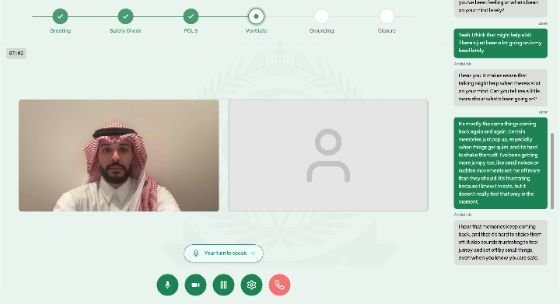
PTSD is widely underreported. We designed and evaluated a multimodal virtual agent that holds a structured screening conversation and administers the PCL-5 checklist, adapted to the language and culture of the people it serves.

  • Design and Evaluation of a Culturally Adapted Multimodal Virtual Agent for PTSD Screening C. Ozel, W. Nadeem, S. Potter, Y. Bokhari, B. Alwuqaysi, W. Alotaibi, R. F. Alnufaie, S. Boughorbel, A. Aljouie, R. Altasan, and E. Hoque ACM International Conference on Intelligent Virtual Agents (IVA 2026), 2026 PTSD is widely underreported among military personnel. Molhim is a culturally adapted, LLM-driven virtual avatar that conducts structured screening conversations and administers the PCL-5 checklist in a military healthcare setting.

Sensing to support prolonged exposure therapy

An NSF-funded collaboration (2019 to 2023) with Rosa Arriaga, Barbara Rothbaum, Andrew Sherrill and Thomas Ploetz developed the Prolonged Exposure Collective Sensing System (PECSS), sensing tools to support prolonged exposure therapy, a leading treatment for PTSD.

More

← All research