Mental health signals in everyday online behavior

Most people never get screened for depression or anxiety, and people experiencing abuse often do not ask for help. But what we search for and watch online changes when our mental health does. With volunteers who shared their anonymized Google Search and YouTube histories alongside clinical assessments, we studied whether these everyday traces can flag depression, anxiety and intimate partner violence early, privately and at scale.

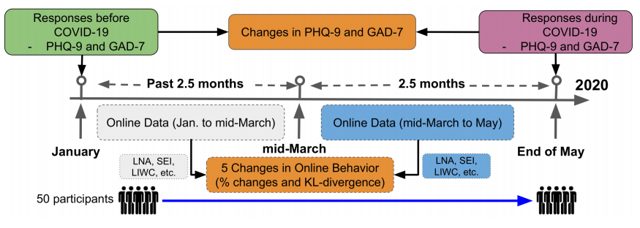
Changes in students' Google and YouTube use tracked worsening depression and anxiety during COVID-19 (JMIR Mental Health 2020).
212participants with search and YouTube histories and clinical depression assessments
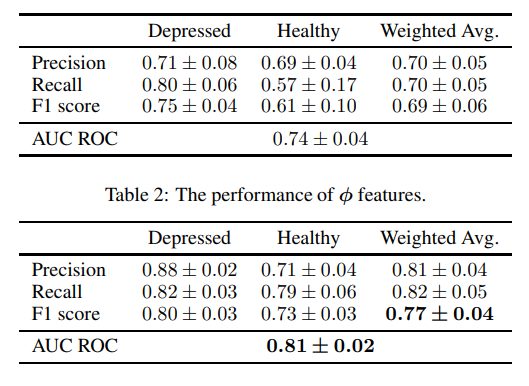
AUC 0.81identifying people with depressive symptoms from their online activity
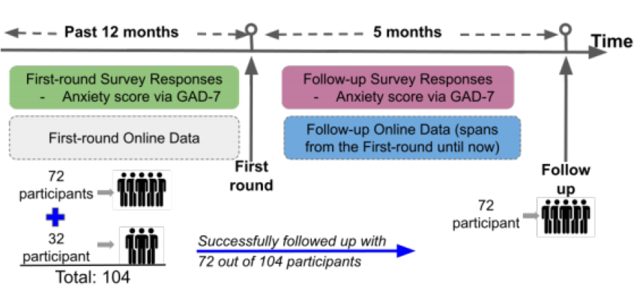
F1 0.83detecting anxiety disorder from longitudinal search and YouTube logs

2020

Mental health during COVID-19

We followed 49 college students from January 2020, before the pandemic, to May 2020. About half got more depressed or more anxious on standard questionnaires (PHQ-9 and GAD-7), and changes in how they used Google and YouTube correlated strongly with those changes. Simple models built on five behavioral features predicted the changes well.

2020 to 2021

Detecting depression and anxiety

Modeling both the timing and the content of people's searches and videos, a personalized classifier distinguished people with and without depressive symptoms (average F1 0.77, AUC 0.81) among 212 participants, 99 with moderate to severe depression. A related model detected anxiety disorder (average F1 0.83) and estimated its severity on the 0 to 21 GAD-7 scale with a mean squared error of 1.87.

2020

Signs of intimate partner violence

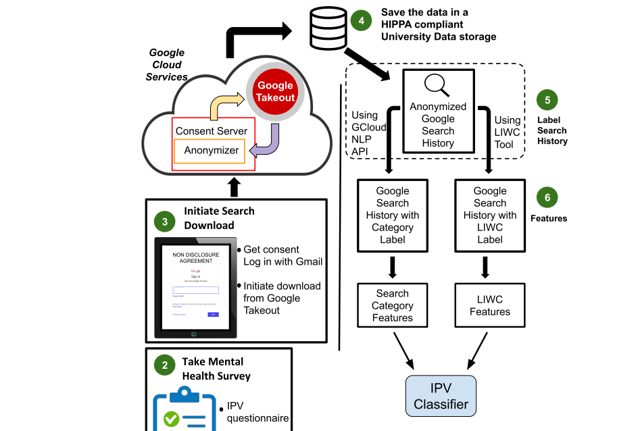
Web search histories can also reveal signs of intimate partner violence, which suggests new ways to reach people who may not seek help on their own.

  • Discovering Intimate Partner Violence from Web Search History A. Zaman, H. Kautz, E. Hoque, V. Silenzio, C. Nichols, and C. Cerulli IEEE/ACM Conference on Connected Health (CHASE 2020), 2020 Web search histories can reveal signs of intimate partner violence, suggesting new ways to reach people who may not seek help.

People

Led by PhD student Anis Zaman with Boyu Zhang, Henry Kautz, Vincent Silenzio and Catherine Cerulli.

More

← All research