Recording and analyzing deception at scale
The Automated Dyadic Data Recorder lets pairs of people hold honest or deceptive conversations online, so deception can be studied at scale. Follow-on work found facial cues of lying, gender differences in deceptive expressions, and how facial features change the meaning of words.
-
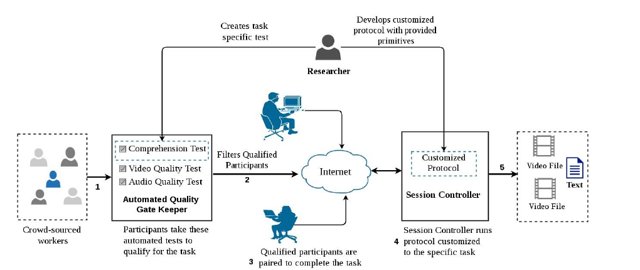 Automated Dyadic Data Recorder (ADDR) Framework and Analysis of Facial Cues in Deceptive Communication
A framework for recording and analyzing honest and deceptive conversations online, revealing the facial cues of lying. Covered by Newsweek and The Times.
-
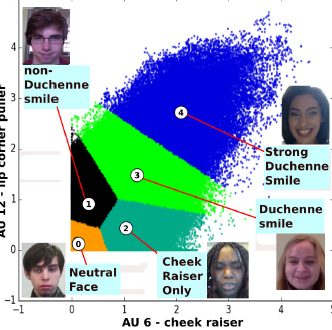 Say CHEESE: Common Human Emotional Expression Set Encoder Analysis of Smiles in Honest and Deceptive Communication
Smiles differ subtly when people are lying. A smile-encoding model finds those differences in honest and deceptive conversations.
-
 Facial Expression Based Imagination Index and a Transfer Learning Approach to Detect Deception
Facial expressions reveal when people are imagining rather than recalling, a signal useful for detecting deception.
-
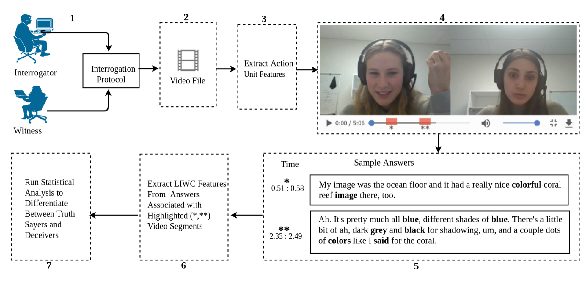 LIWC Into the Eyes: Using Facial Features to Contextualize Linguistic Analysis in Multimodal Communication
Combines facial expressions with word-level language analysis to better interpret what people mean.
-
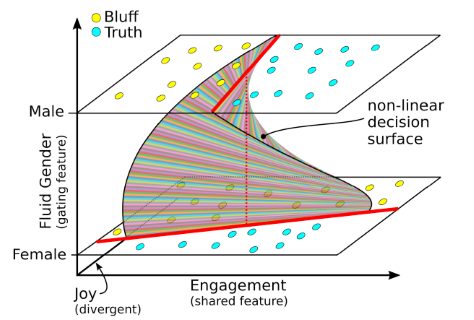 Leveraging Shared and Divergent Facial Expression Behavior Between Genders in Deception Detection
Men and women show different facial cues when lying. Modeling those differences improves deception detection.
-
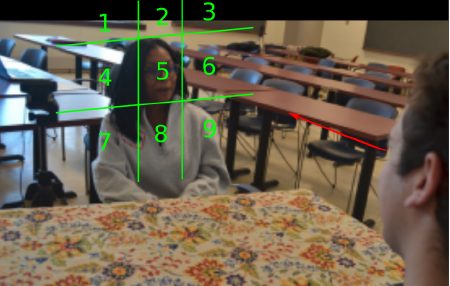 Are You Really Looking at Me? A Feature-Extraction Framework for Estimating Interpersonal Eye Gaze from Conventional Video
Estimates whether people are making eye contact using ordinary video, with no eye tracker needed.